Josh Ramirez
← Back to the journal

Departed 2012 · still in the field

Decade of 3D

3D, as a craft · 3D / Arch viz · In the field

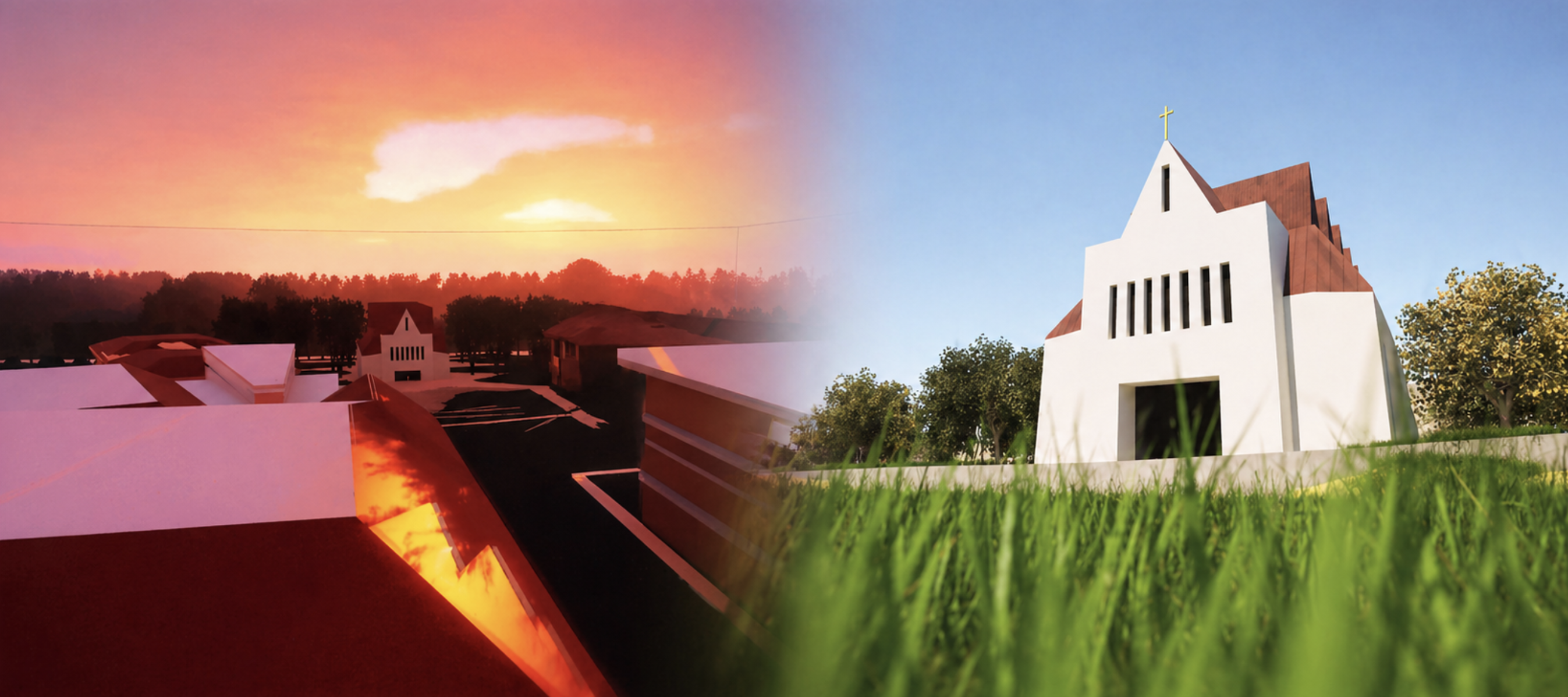
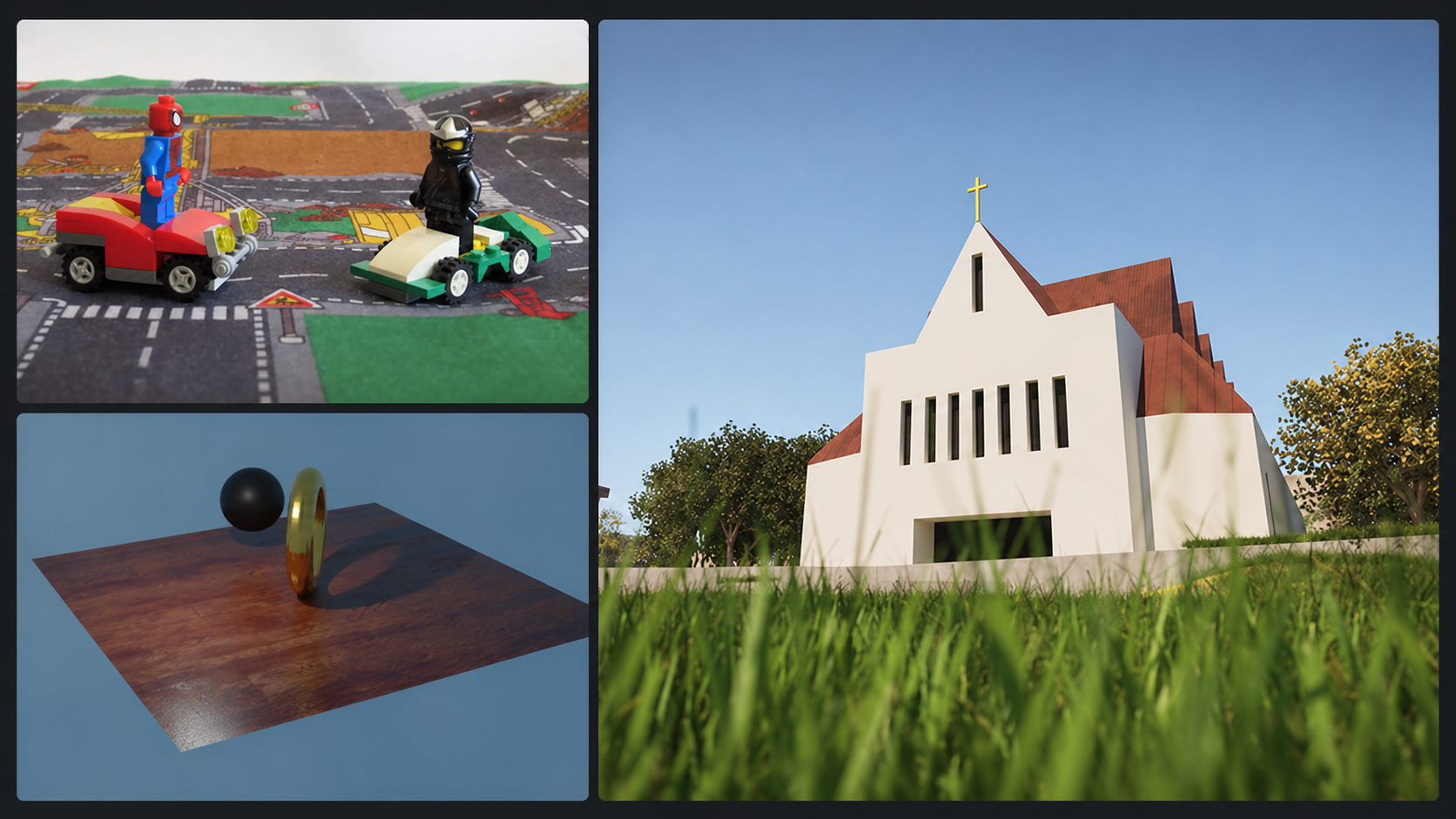
Side-by-side spanning thirteen years — left, a stacked pair: a child's playmat photo with a Spider-man Lego figure in a red car next to another Lego in a white-and-green car, beneath it a very primitive 3D render of a black sphere and a gold ring resting on a square plane with dark wood texture; right, a large realistic high-quality 3D architectural render of a modern white church building with a multi-tiered red roof shot from a low angle looking up through tall detailed green grass
From stop motion to real-time rendering — the same thread, thirteen years apart.

Departure

08/22/2012 22:06 — Lego on a playmat, a Spider-man figure in a red car, a phone propped up for the next frame. That timestamp is the start of the thread. From there it ran through Blender's default cube and Andrew Price's donut, into Houdini and ZBrush and Fusion 360, into a low-poly pass at the loft game room that got redone until the JOOLA net read and light beamed through the brick window cutouts. Thirteen years later it's still the same thread — just running through Twinmotion, photogrammetry, MetaHumans, and Gaussian splats now.

Approach

  • Blender
  • Houdini
  • ZBrush
  • Fusion 360
  • Twinmotion
  • Unreal
  • Photoshop
  • After Effects
  • CapCut
  • Photogrammetry

No school for it, no formal mentor — every era of the craft picked up the same way: pick a tutorial, pick a project, render until it doesn't look broken.

Field log

  1. Aug 22, 2012 — 22:06

    First frame I called animation. Lego on a playmat, a phone propped up for the next shot. The timestamp is on the photo, burned in red.
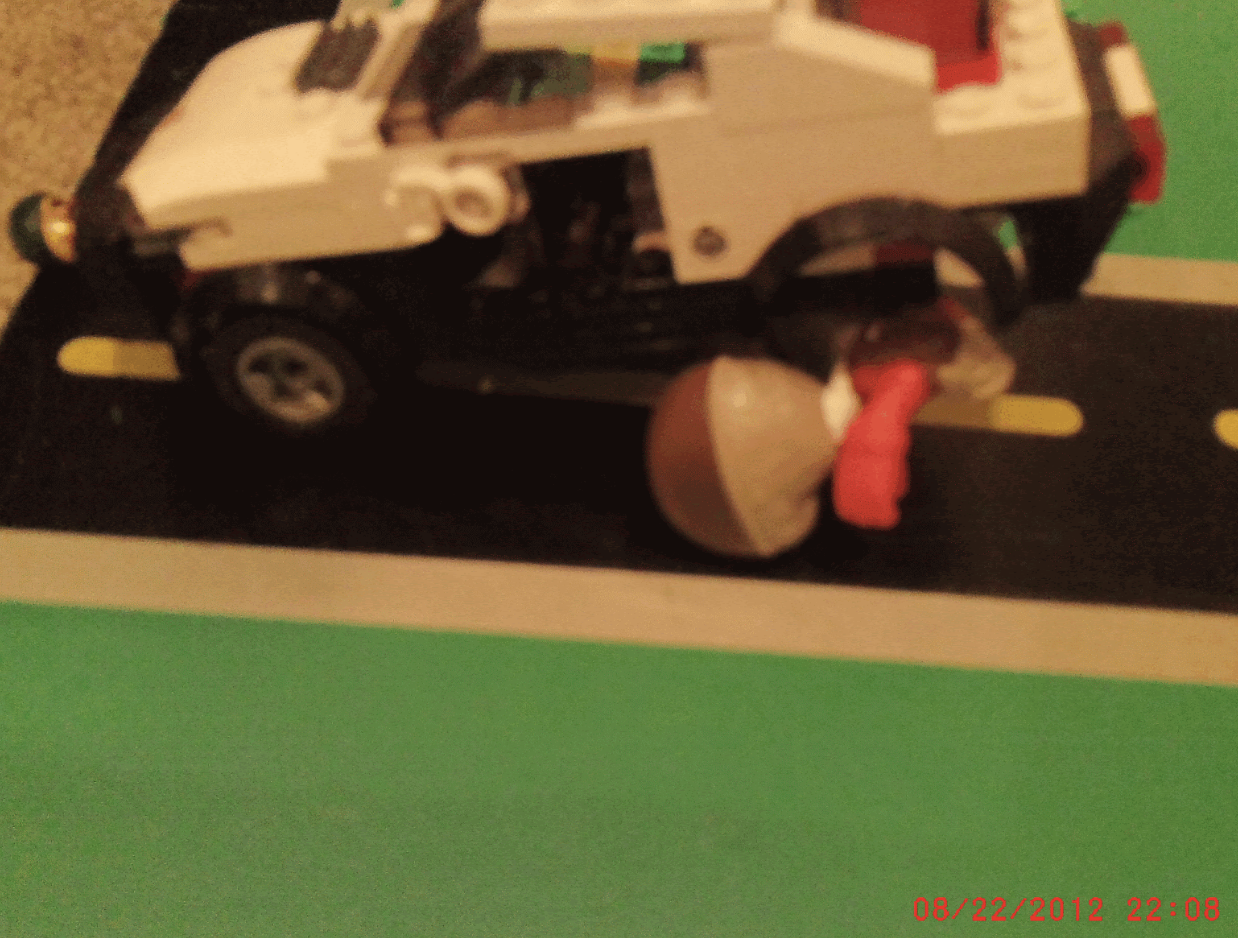
    08/22/2012 22:06 — low-quality slightly blurry photograph of a Lego stop motion setup on a child's road playmat, a Spider-man figure posed in a red Lego car next to another figure in a white-and-green car, the red digital camera timestamp burned into the bottom right corner
    The frame the thread starts at.
  2. 2013 — first 3D render

    Before the cube was a cube. A black sphere, a gold ring, a wood-textured plane. The first thing I'd be willing to put on a slide.
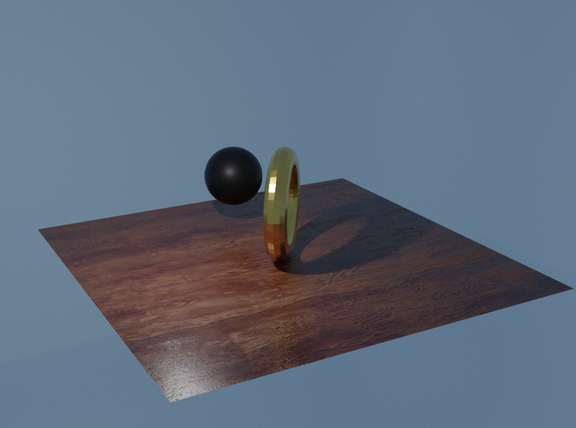
    Very primitive early 3D render — a single black sphere and a gold torus ring resting on a square plane with a flat dark wood texture, no lighting setup beyond defaults
  3. 2013 — Blender, basics

    Vertices, edges, faces. Shift A to add. E to extrude. G, S, R for grab, scale, rotate. The whole alphabet of the program in five keystrokes.
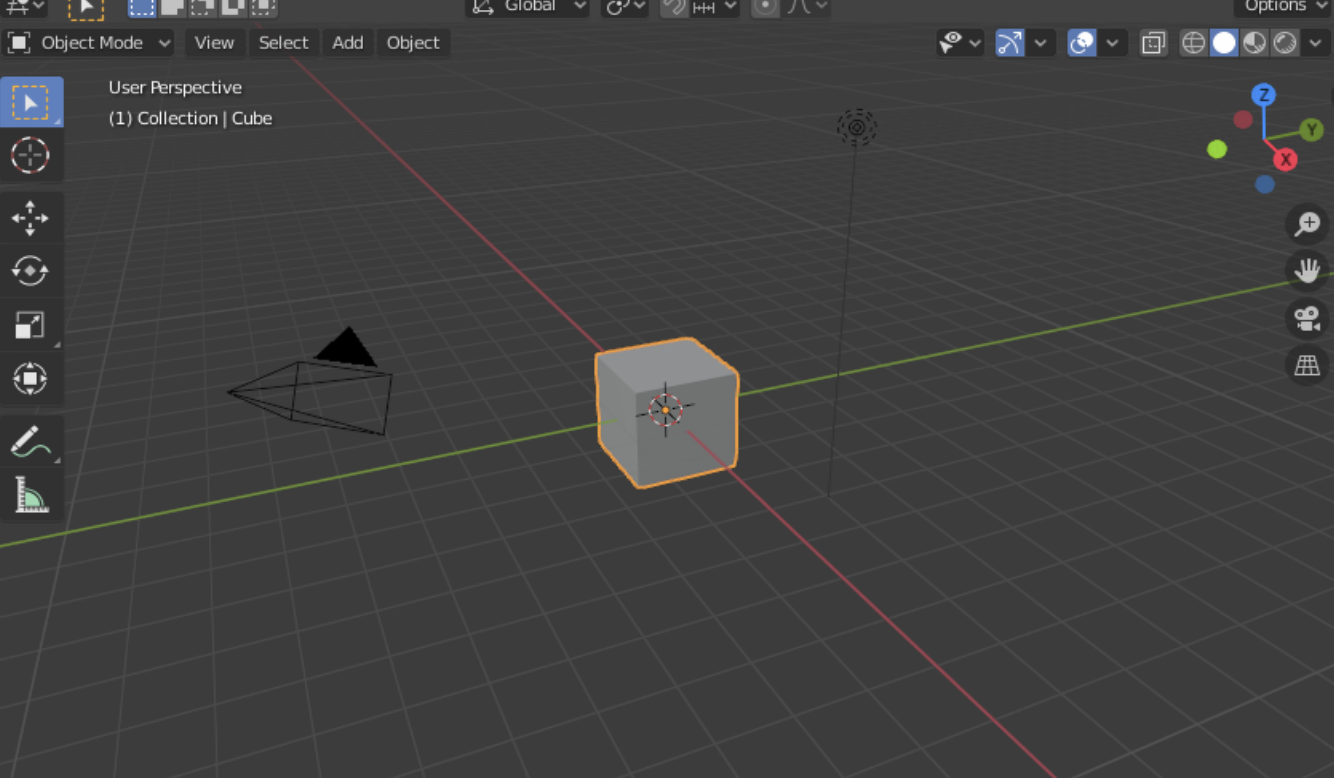
    Blender viewport in Edit Mode showing the default starting cube on a gray grid with orange highlighted vertices, the Shift+A add menu open beside it, small overlay labels indicating Vertices / Edges / Faces
    The default cube. Where everyone starts.
  4. 2014 — first sculpt

    First time I made a thing that had a face. Untextured, but it had cheekbones.
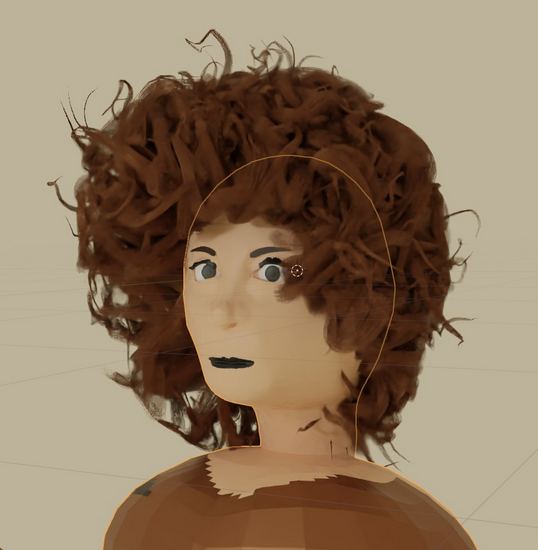
    Fully rendered 3D character bust in Blender — a person with messy brown hair wearing a simple brown tunic, no environment, plain background, sculpted geometry with light enough to read the planes of the face
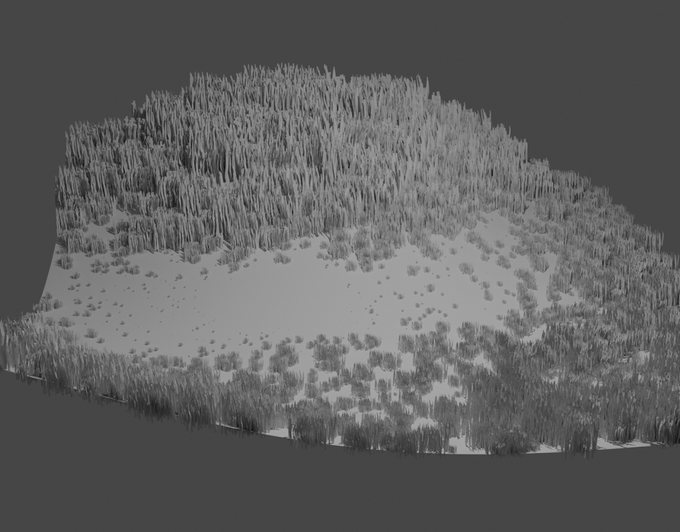
    Gray untextured 3D mesh of a hilly landscape covered in dense geometric bumps representing scattered foliage, no shading beyond default viewport lighting
    Landscape mesh from the same era. Bumps for grass.
  5. 2015 — other software

    Touched Houdini, ZBrush, and Fusion 360 as alternatives around the edges: procedural systems, digital clay, and precision parts. Useful detours, but Blender stayed home base.

  6. 2016 — the loft, photographed

    Wanted to model a real room. Started with the room I was already in.
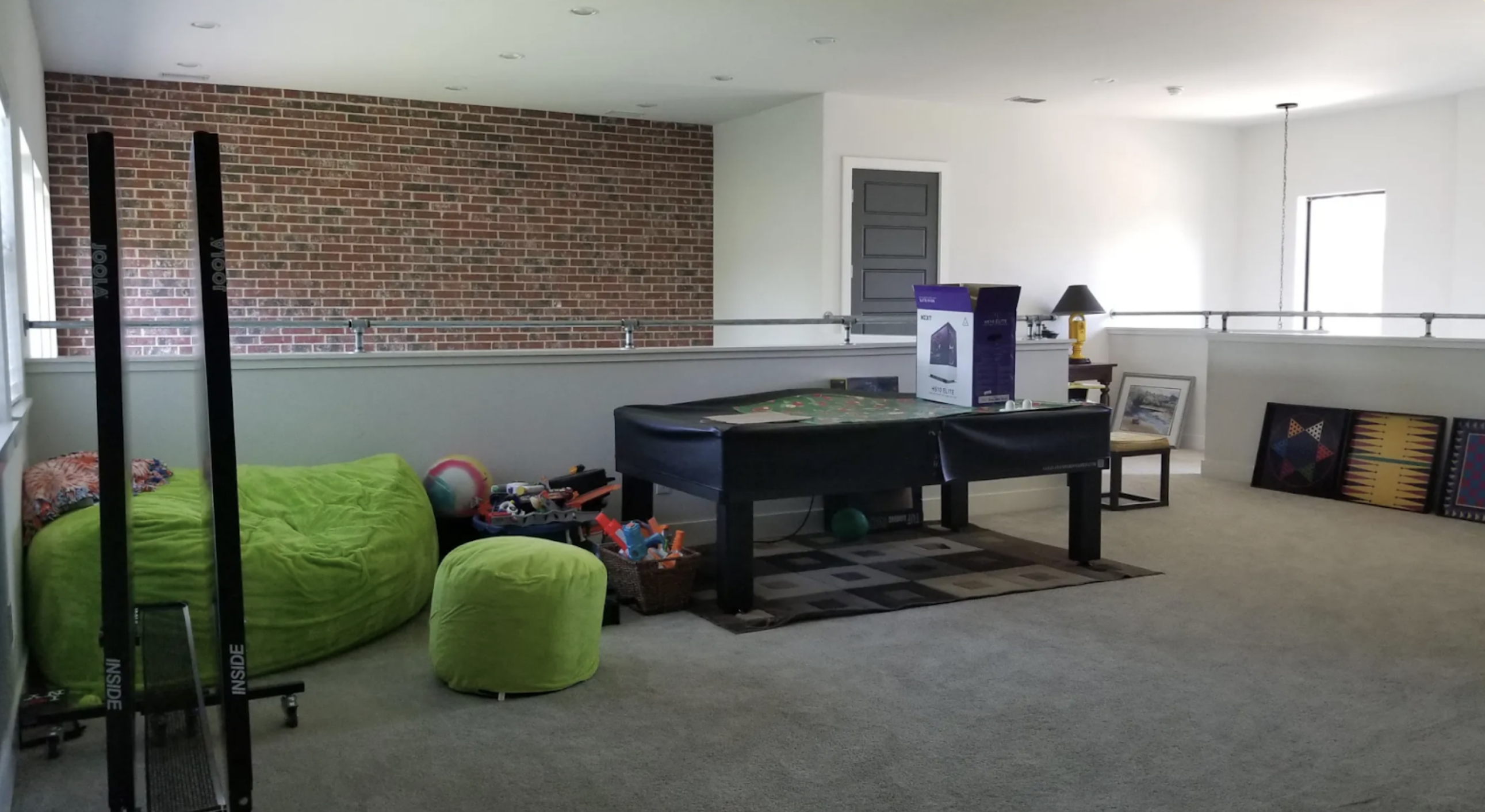
    Real-world photograph of a loft game room — light gray carpeting, white walls, one prominent accent wall of dark red brick with three narrow vertical window cutouts, a metal railing separating the loft from a stairwell, a vertical ping pong net standing on the floor, two large bright green bean bag chairs, small bins overflowing with toys, a covered pool table in the center with a large cardboard box on top, framed board games leaning against the short wall on the right
    Reference photo. The room I was trying to recreate.
  7. 2016 — game room, first pass

    Bean bags as smooth green blobs, pool table as a black slab, windows blown out white. Recognizable, barely.
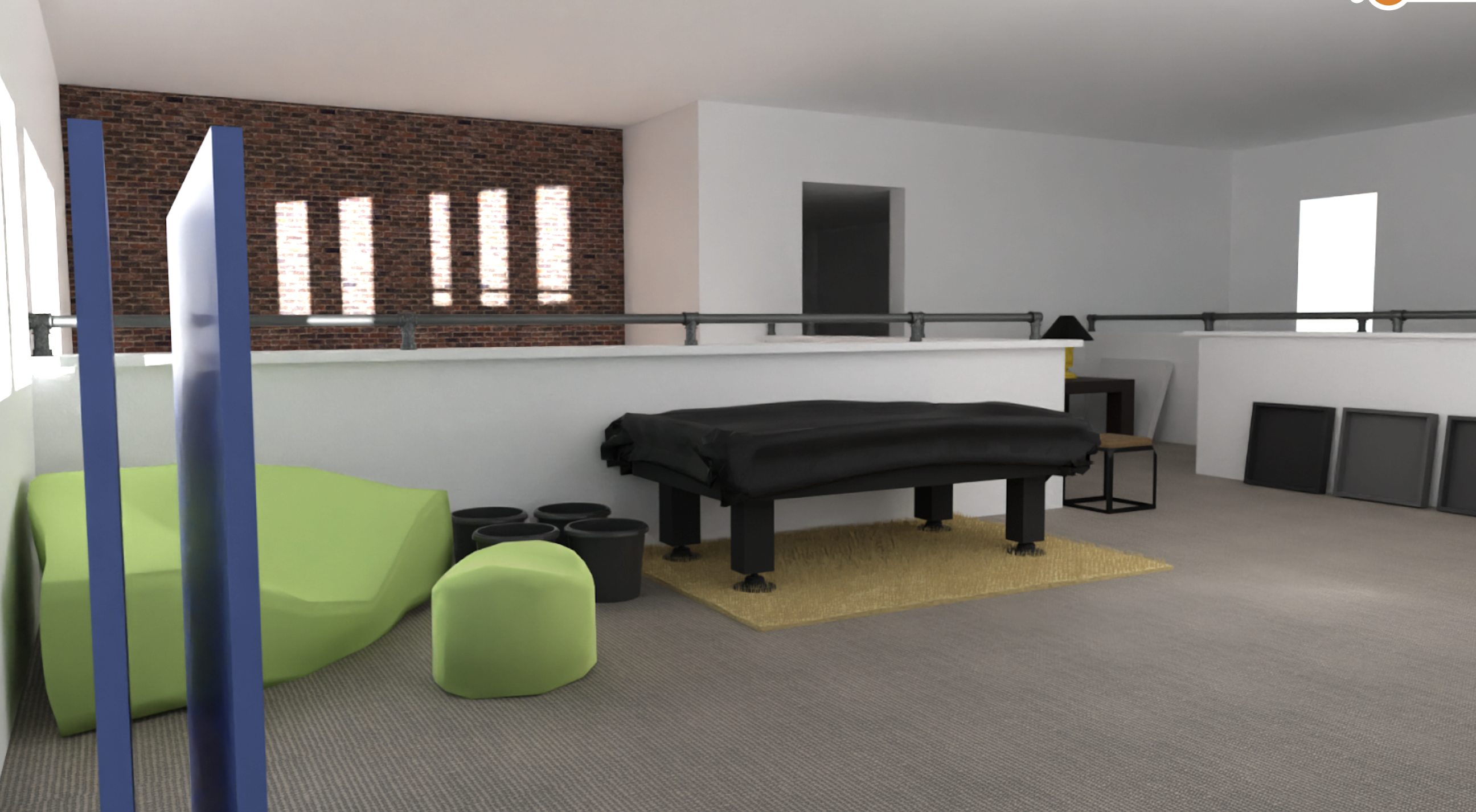
    Early low-poly Blender render attempting to recreate the loft game room — flat white lighting with no realistic shadows, bean bags rendered as solid unnaturally smooth green blobs, pool table as a blocky black structure with thick legs, ping pong net represented by two tall solid blue rectangular pillars, brick wall as a flat texture, three windows glowing as intense blown-out white rectangles, Blender logo in the top-right corner
    Pass one. Geometry only, lighting absent.
  8. 2016 — game room, second pass

    Brick that read as brick, JOOLA stenciled on the net stands, sun rays beaming through the window cutouts and lighting the dust in the air. First time photoreal lighting clicked.
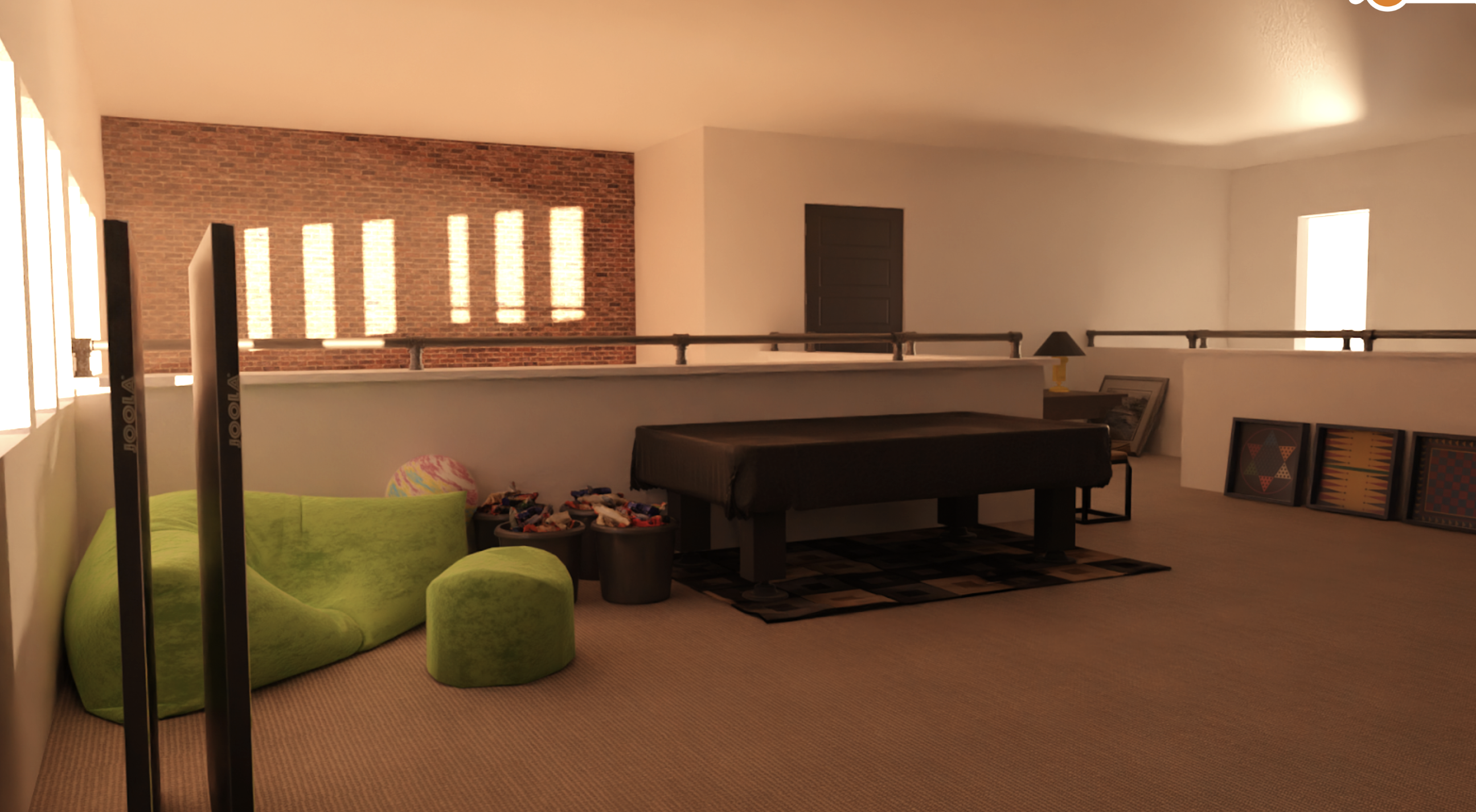
    Significantly improved second-pass Blender render of the same loft game room — warm realistic sunset lighting casting soft shadows across the room, tactile brick wall texture, fuzzy carpet, soft wrinkled bean bags, ping pong net stands with the word JOOLA printed on them, distinct light rays visibly beaming through the window cutouts and illuminating dust in the air, bins next to the bean bags filled with identifiable toy shapes, Blender logo top-right
    Pass two. Lighting did most of the work.
  9. 2017 — primitive renders

    A cluster of early scenes: red bedroom, pink Benchy, marble desk, boxy spaceship, then Bob's Bakery. The bakery was the first one with a real mood: wet street, neon sign, brick.
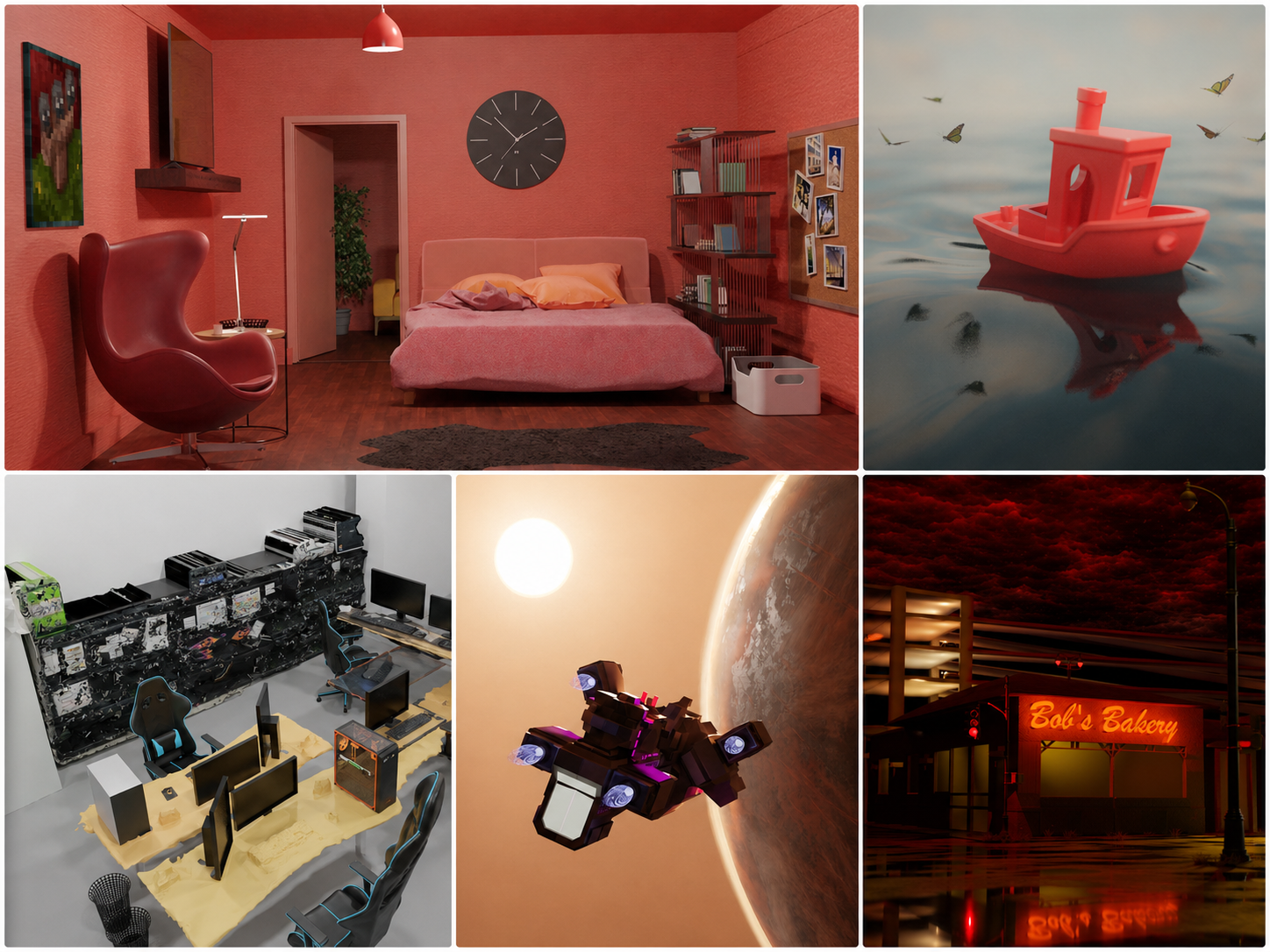
    Five-image collage of 2017 3D renders — top-left a stylized red bedroom, top-right a glossy pink Benchy tugboat floating on water with butterflies, bottom-left an overhead marble-desk computer setup, bottom-center a boxy spaceship near a tan planet and bright sun, bottom-right Bob's Bakery at night with a glowing red neon sign reflected on a wet street
    Red bedroom, pink Benchy, marble desk, boxy spaceship, and Bob's Bakery.
  10. 2018 — texturing, the node wall

    Procedural blocks guiding what each surface looks like. Dozens of node types, none of them obvious. Image textures meant UV unwrapping, which meant another tutorial.
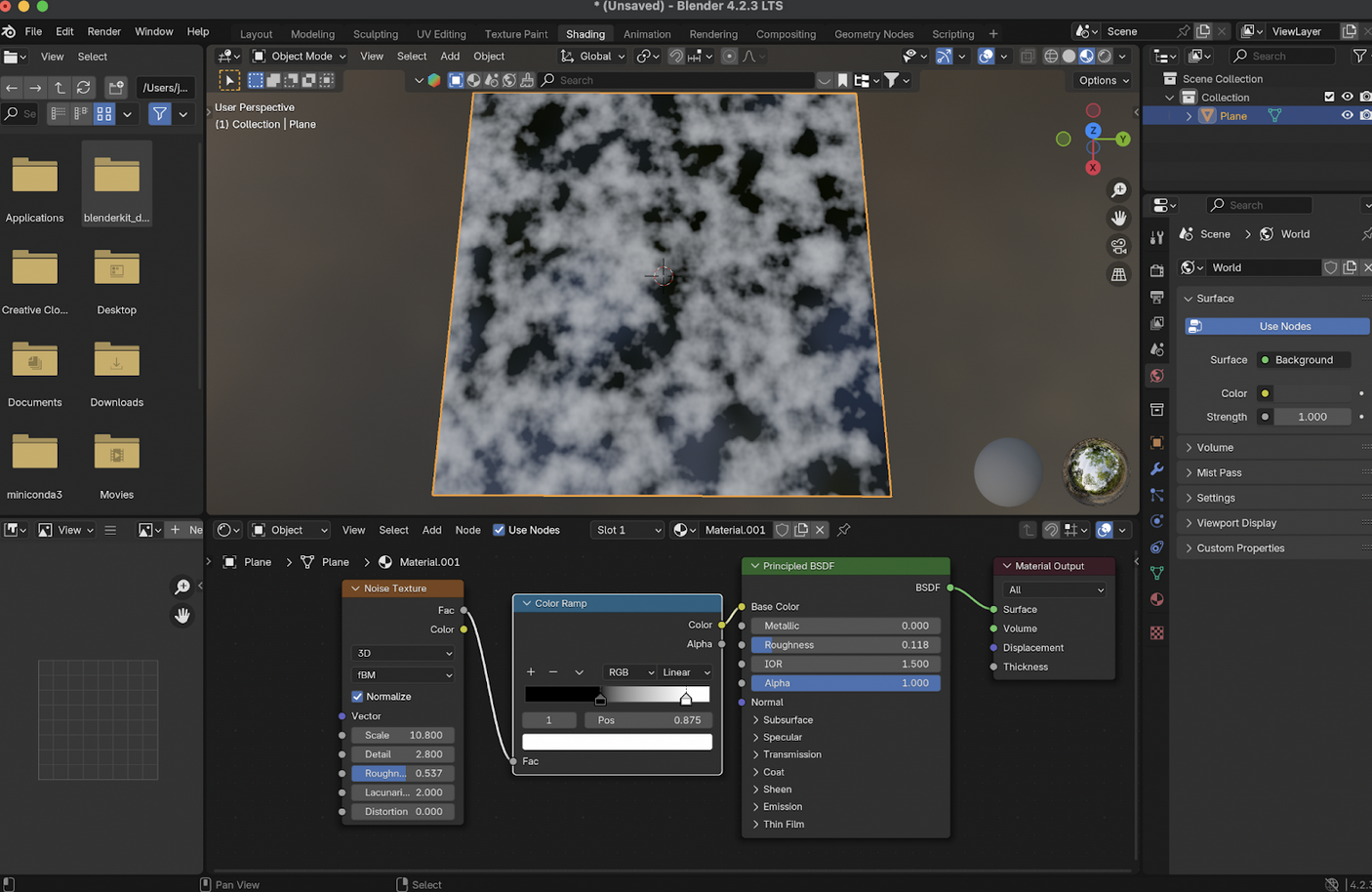
    Blender Shader Editor screenshot — simple node tree with a Noise Texture node connected to a Color Ramp node feeding into the Base Color of a Principled BSDF material, output going to Material Output, viewport above showing a flat plane displaying the resulting black-and-white cloudy procedural pattern
    Noise → Color Ramp → Principled BSDF. The starter graph.
  11. 2018 — bad floor / good floor

    Same wood plank, two different node graphs. The flat one looked like a screensaver; the layered one looked like a floor.
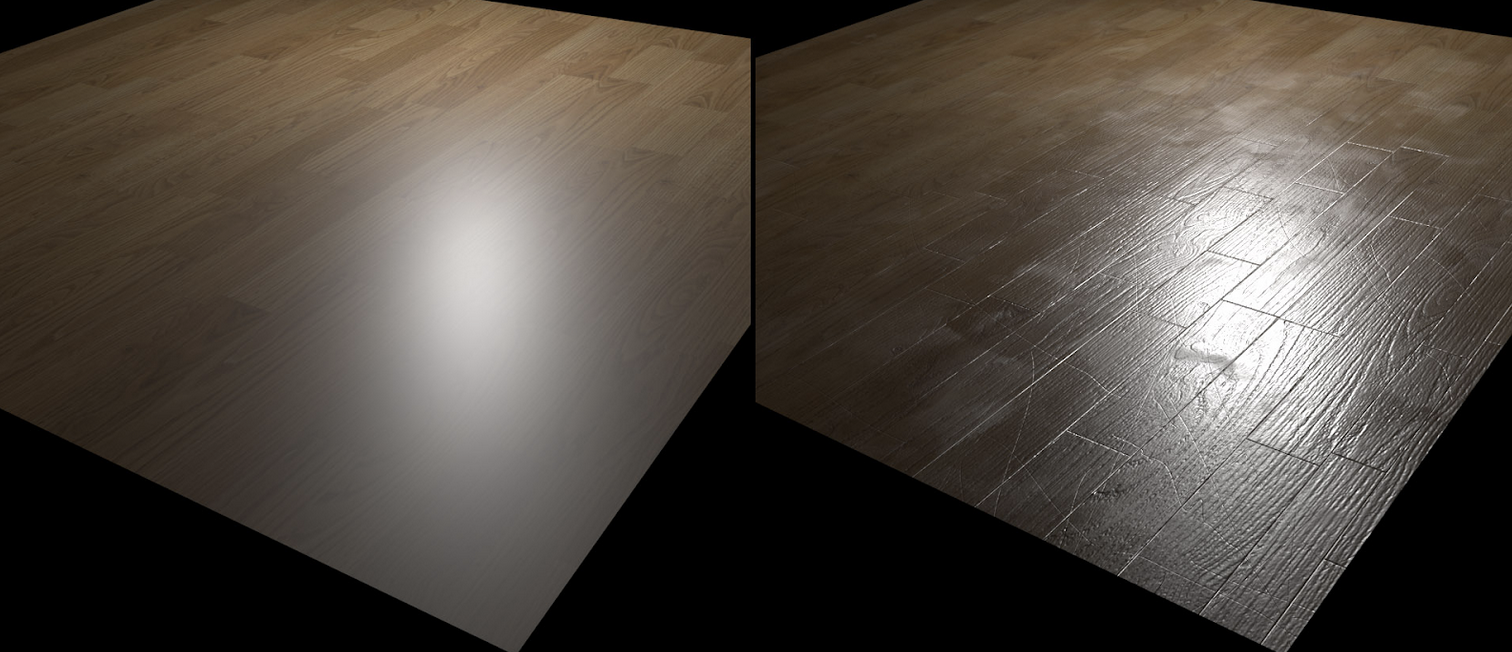
    Side-by-side wood floor texture comparison — left labeled BAD TEXTURING, a flat dull unrealistic wood plank texture tiling visibly with no variation; right labeled GOOD TEXTURING, a highly detailed wood floor with varied reflections, subtle bumps, worn grain, and realistic lighting bouncing across the planks
    Bad vs good. The same plank, two different graphs.
  12. 2018 — lighting clicked

    Point, sun, spot, area. Same model, two passes. The useful lesson was simple: the cinematic version was mostly lighting, not better geometry.
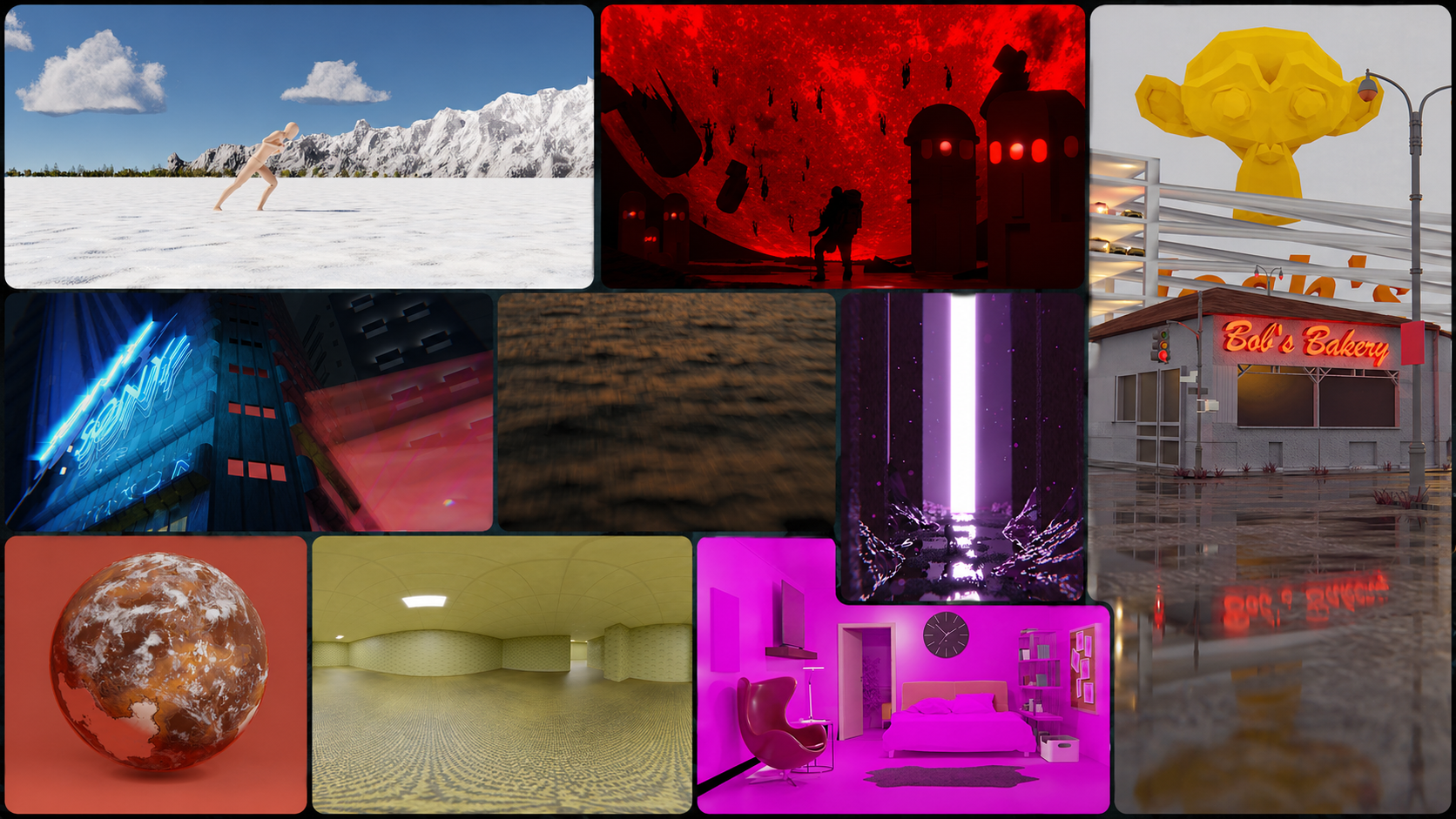
  13. 2019 — practice, in bulk

    Multi-image collage of 2019 practice 3D renders — a faceless mannequin running across a white plain toward snowy mountains, a red alien moon scene with an astronaut silhouette, a cyberpunk alley with a bright blue neon sign, a dark canyon split by a vertical white light shaft, a monochrome pink bedroom, plus related experimental renders including Bob's Bakery with a yellow Suzanne head, a red planet, and a Backrooms-style yellow interior
    Mannequin and a mountain, cyberpunk alleyway, astronaut and the red moon, pink bedroom, and light shaft canyon.
  14. 2019 — lighting cont. (cat eye)

    Reflection lesson. The earth on the left, the same earth reflected in the cat's eye on the right. Made me actually understand reflection probes.
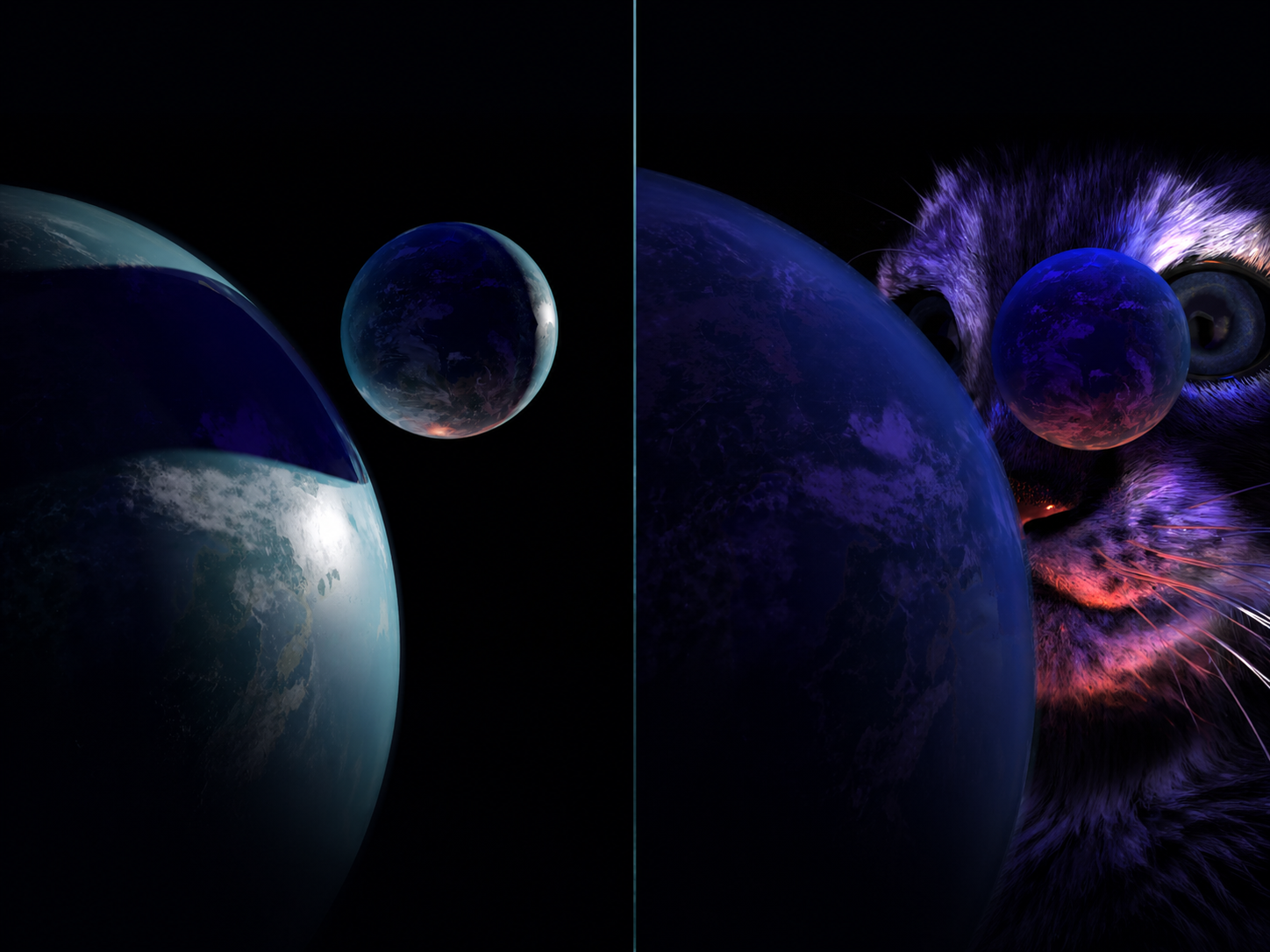
    Two images side by side — left, a view from outer space with a large partially shadowed earth-like planet dominating the foreground and a smaller darker moon-like planet in the distance against the blackness; right, a highly detailed surreal close-up of a furry cat's face bathed in purple and pink light, the exact earth-like planet from the left image reflected perfectly and clearly in the cat's large glossy eye
    The right image taught me what reflection meant.
  15. 2020 — renaissance

    Came back with new tools and new patience. After Effects for compositing, Photoshop for textures, Premiere/CapCut for cutting.

  16. 2020 — Photoshop & After Effects

    Ps for the still pass, Ae for anything that moved. ESD Robotics title cards were the first time the 3D work showed up somewhere other than my own folder.
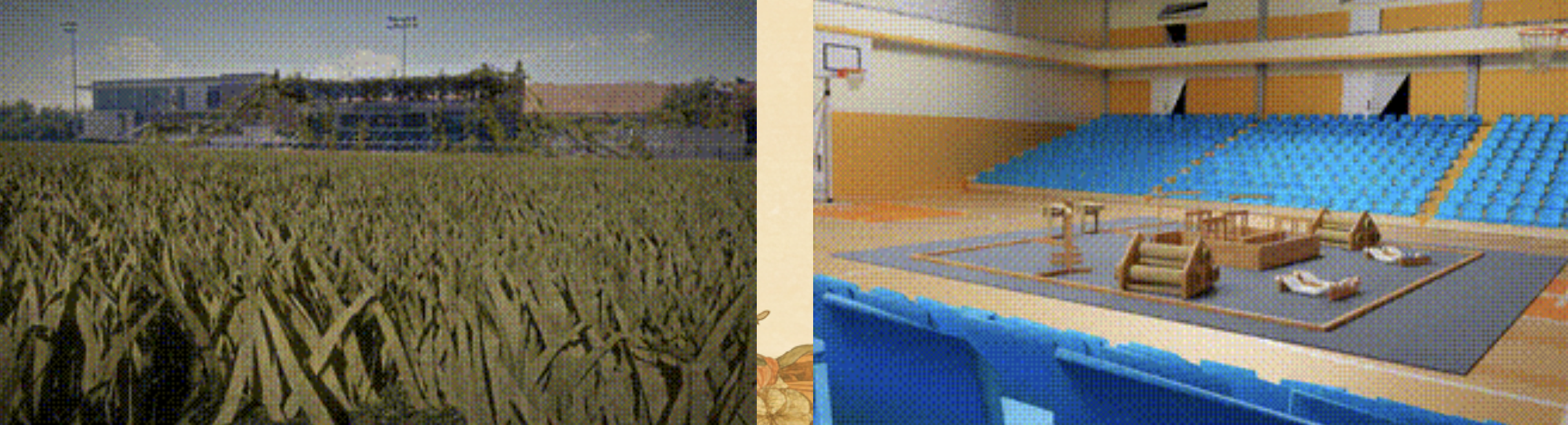
    Vintage parchment background with a painted floral border — large logos for Adobe Photoshop (dark blue square with light blue Ps) and Adobe After Effects (dark blue square with light purple Ae) shown side by side with a black plus sign between them; below, two reference images: a photograph of a green leafy crop field with a long building structure in the distance, and a graphic title card with the text ESD Robotics in glowing white stylized letters against a dark textured background
    Compositing tools, plus the first paid-ish use of any of it.
  17. 2021 — interactive worlds

    Stopped just rendering and started entering. Assetto Corsa for cars, Blender for the layout of an entire building, Fortnite Creative for a hallway you could run down.
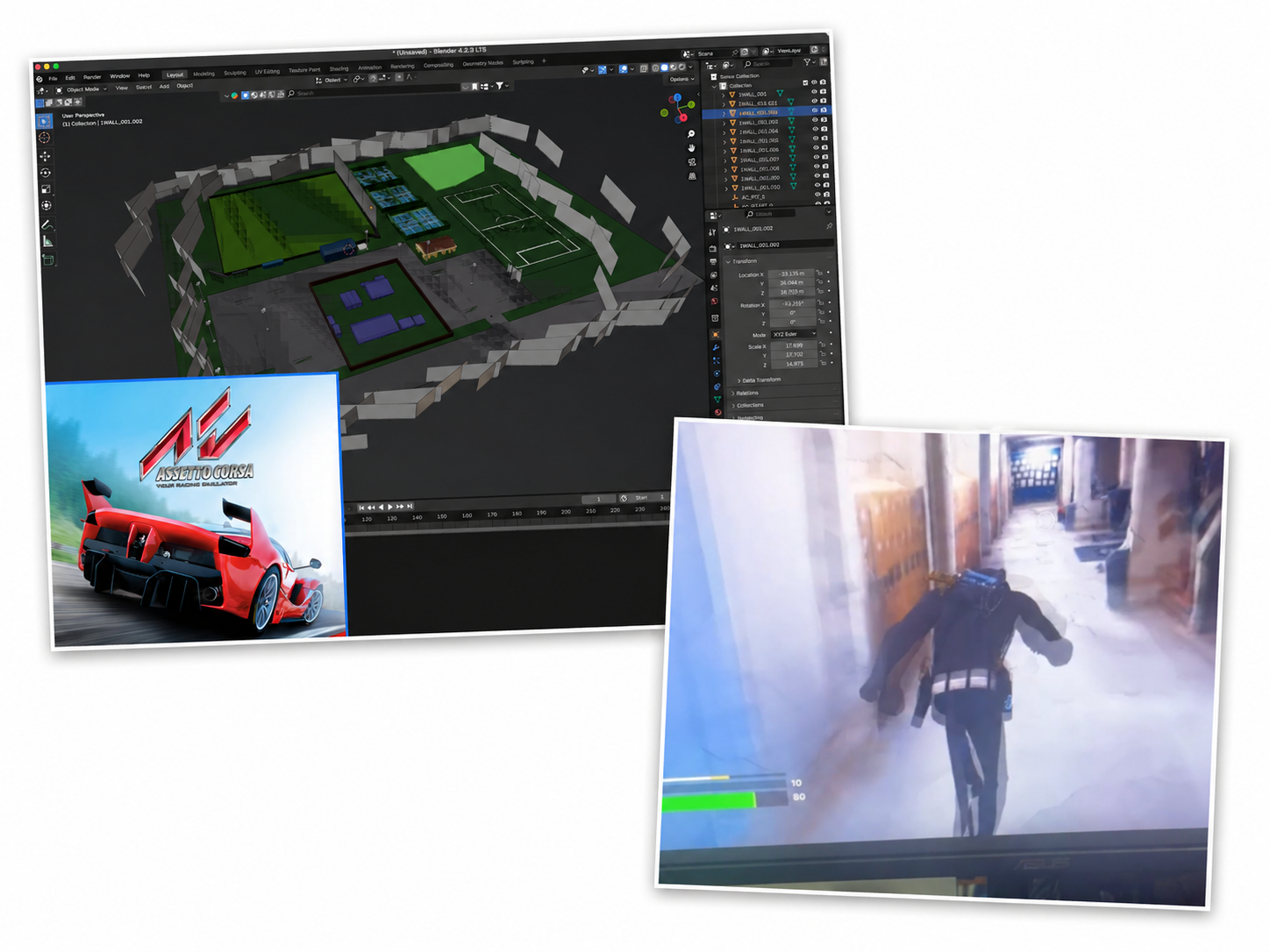
    Three side-by-side examples of interactive 3D worlds on a parchment background — left, the Assetto Corsa logo above a bright red sports car render; middle, a Blender screenshot showing a top-down angled view of an untextured 3D model of a complex building with courtyards and sports fields including green grass patches; right, a Fortnite gameplay screenshot from third person showing a character in a dark outfit and backpack running down a brightly lit indoor hallway lined with lockers and doors
    Cars, layouts, hallways. 3D as places, not pictures.
  18. 2022 — real world → 3D

    Photogrammetry classroom scan came back jagged with chunks of missing wall; the NGP version came back as a brown blur. Both useful in the same way: they showed me where the frontier wasn't, yet.
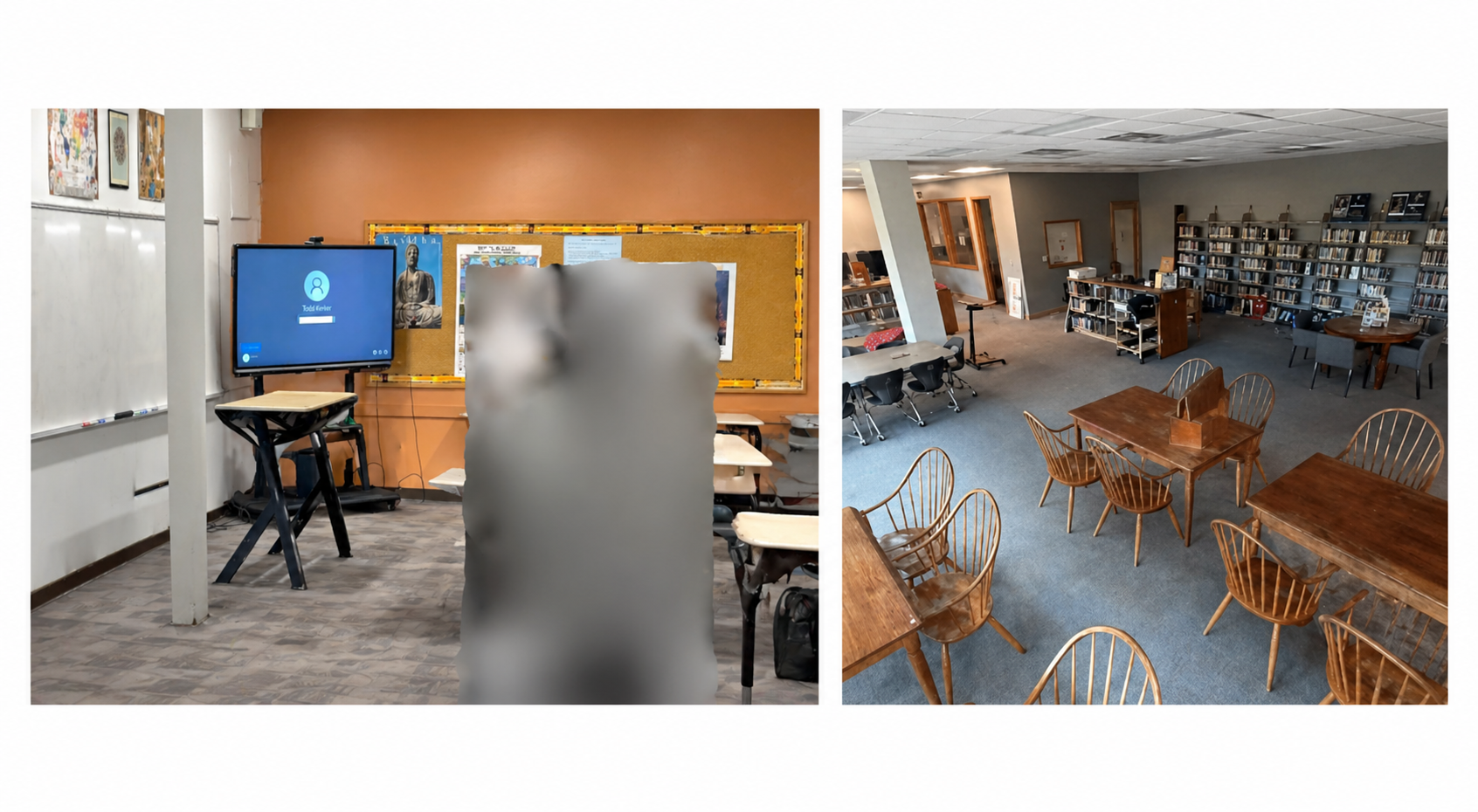
    Two-image collage comparing real-world-to-3D capture attempts — left, a photogrammetry-style classroom reconstruction with a large gray failed region where the scan dropped data in front of a smartboard and classroom wall; right, a clean reference photo of a library or classroom space with tables, wooden chairs, bookshelves, and a gray carpeted floor
    Photogrammetry and NGP attempts. Where the algorithm gave up, the lesson started.
  19. 2022 — animation gets harder

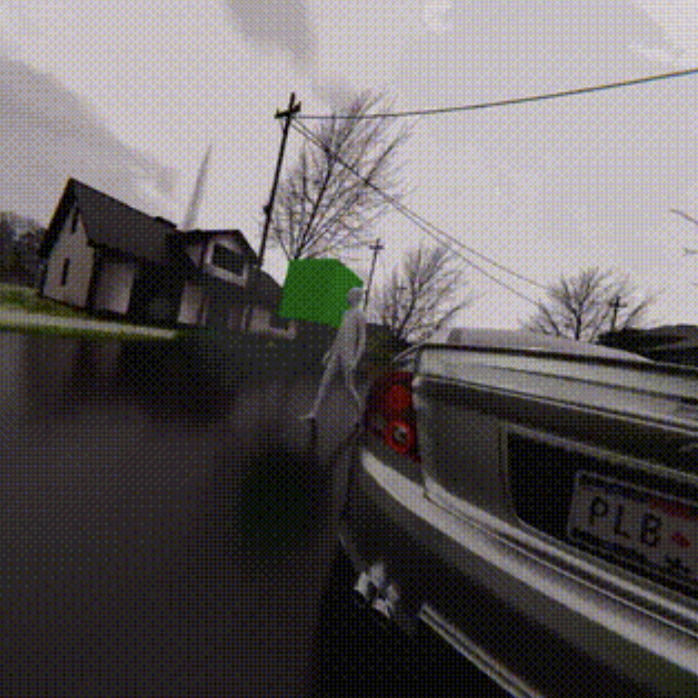
    Realism animation was the dashcam exercise: wet suburban road, gray sky, parked cars, low camera. The other end of the same year was pure complexity.
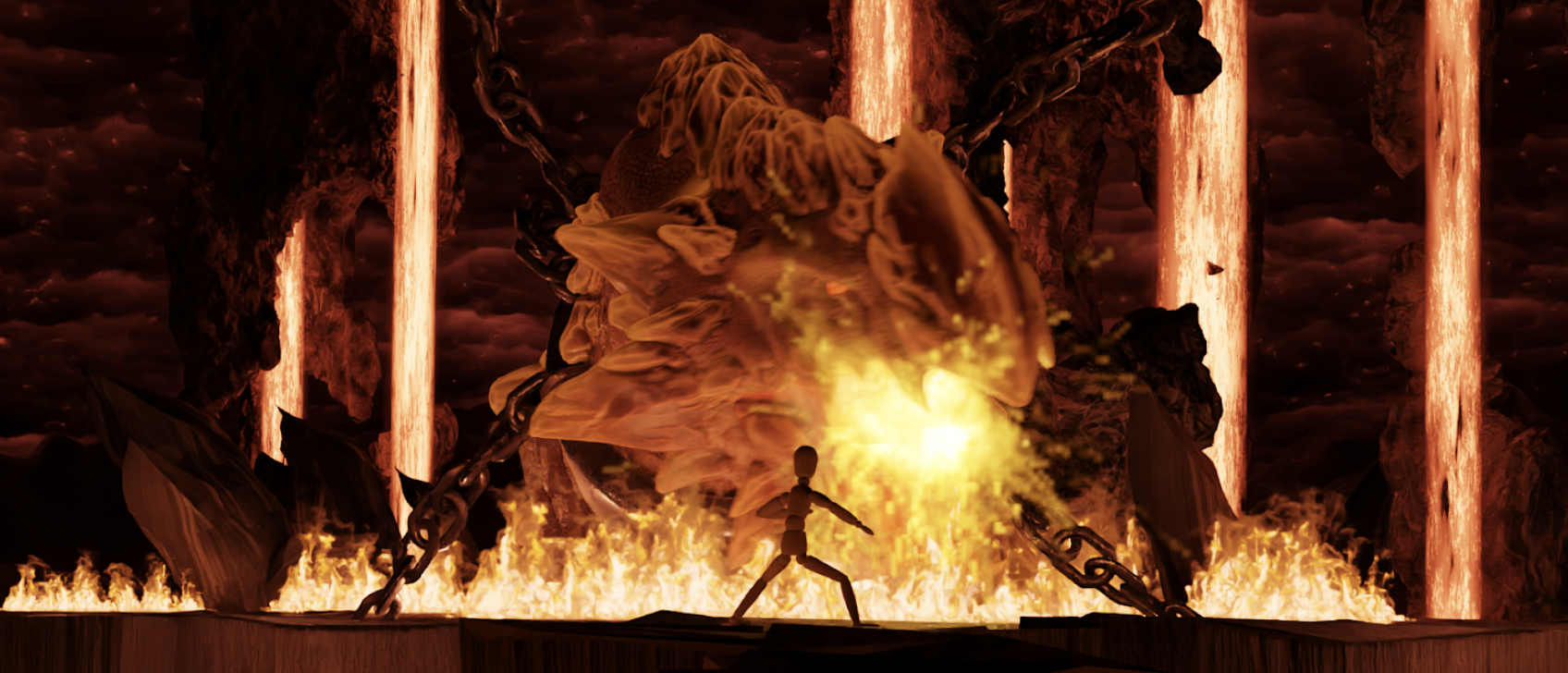
    Intensely dramatic and chaotic 3D fantasy scene — a small silhouetted humanoid figure on a ledge facing a colossal terrifying monster made of fleshy textures, surrounded by roaring flames, falling lava, and massive dark iron chains hanging from the ceiling of an underworld-like cave
    Complexity. The other end of the same year.
  20. 2023 — modern age: VFX & Twinmotion

    Twinmotion arrived and the lighting problem mostly went away. The stylized cyberpunk frame became my standing test render — easy geometry, hard mood.

  21. 2023 — VFX, the kid in the snow

    Body tracking on a real kid in red pajamas, then the same kid composited into a snowy 3D environment with penguins. It is exactly as awkward as it sounds, and exactly as much fun.
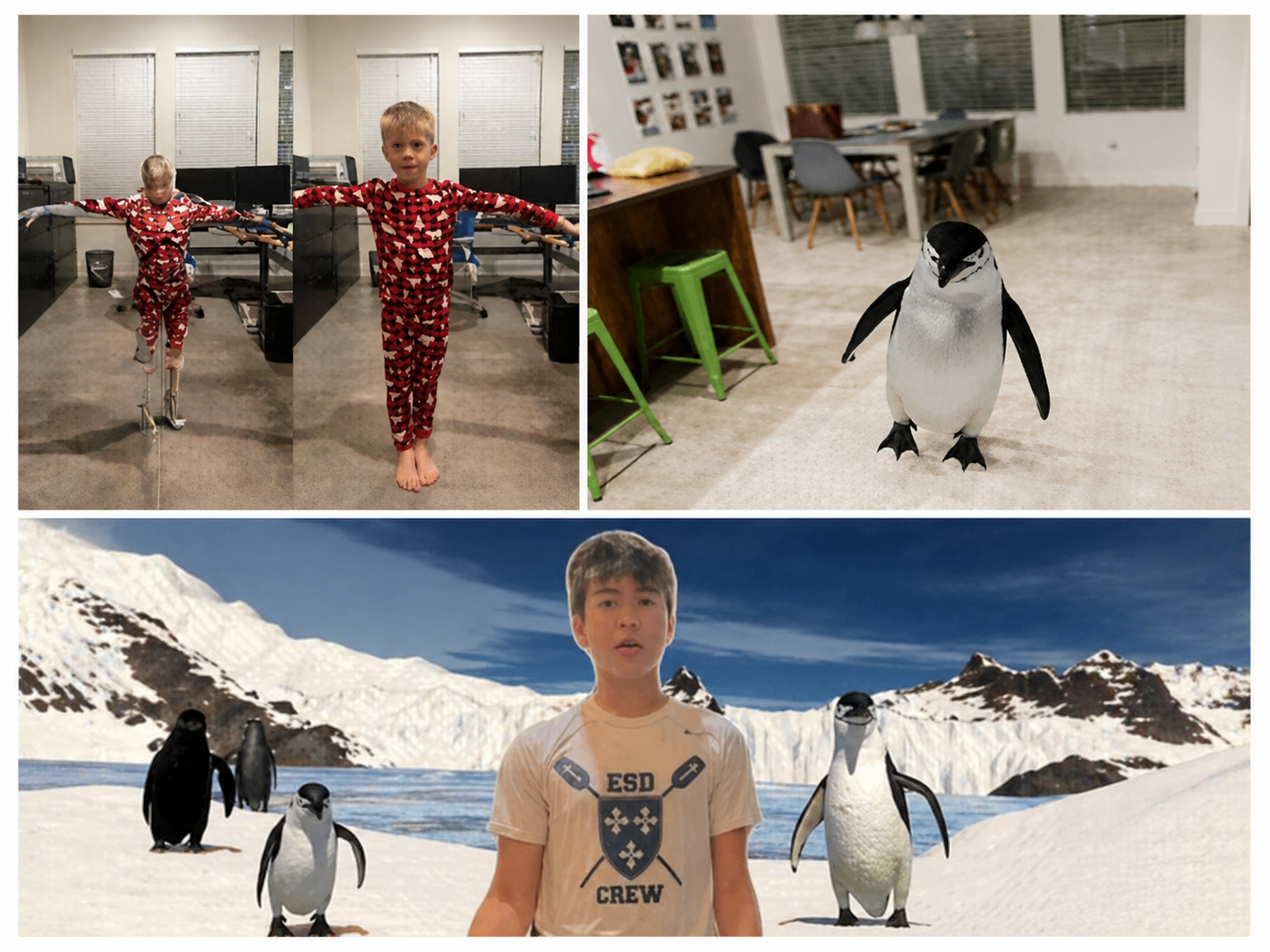
    Three-image VFX collage — top-left, two frames of a young boy in red pajamas standing with arms out for body tracking; top-right, a penguin composited into a real indoor room; bottom, a young man in a white ESD Crew shirt composited into a snowy 3D environment with penguins and glacier mountains behind him
    Body tracking, penguin compositing, and the snow scene.
  22. 2023 — real spaces, digital cars

    Photographed a messy office floor, dropped a Porsche onto the carpet, matched the lighting until you almost believed it. On the side: point-cloud scans of hallways and storage rooms, just to see what the scanner could and couldn't hold.
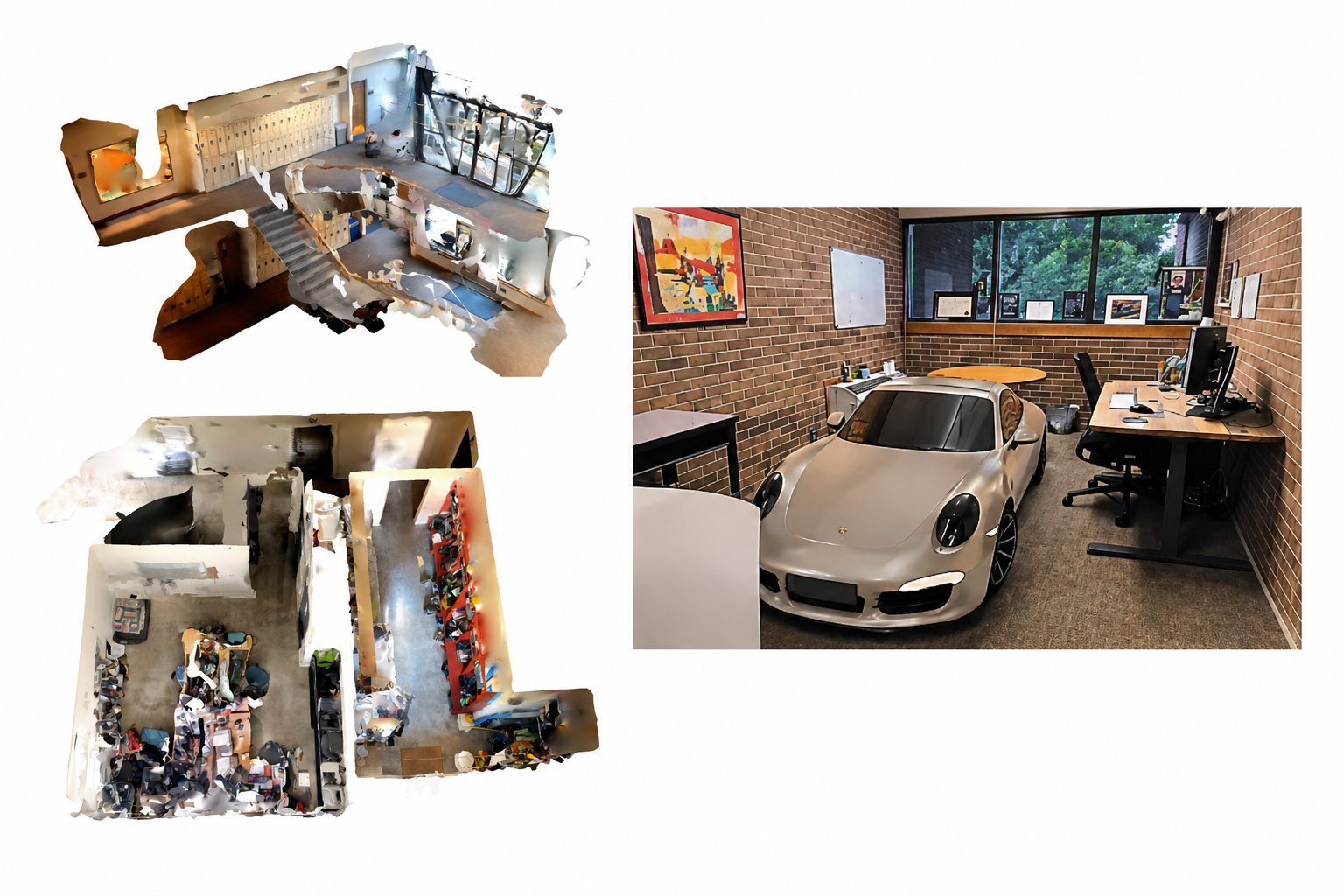
    Collage of real-space 3D experiments — a messy real-world office with a silver Porsche composited onto the carpet, plus top-down point-cloud scans of interior spaces including hallways, stairs, lockers, and storage rooms with rough photogrammetry edges
    Porsche on the office floor, plus point clouds of hallways and storage.
  23. Summer 2024 — ESD Pavilion

    The biggest single project in the whole arc. Walked the campus with a camera, RenderDoc'd a Google Earth frame for the underlying mesh, blocked it out in Blender, textured it, exported to Twinmotion, planted trees by clicking dots on a top-down blueprint until the perimeter filled in.
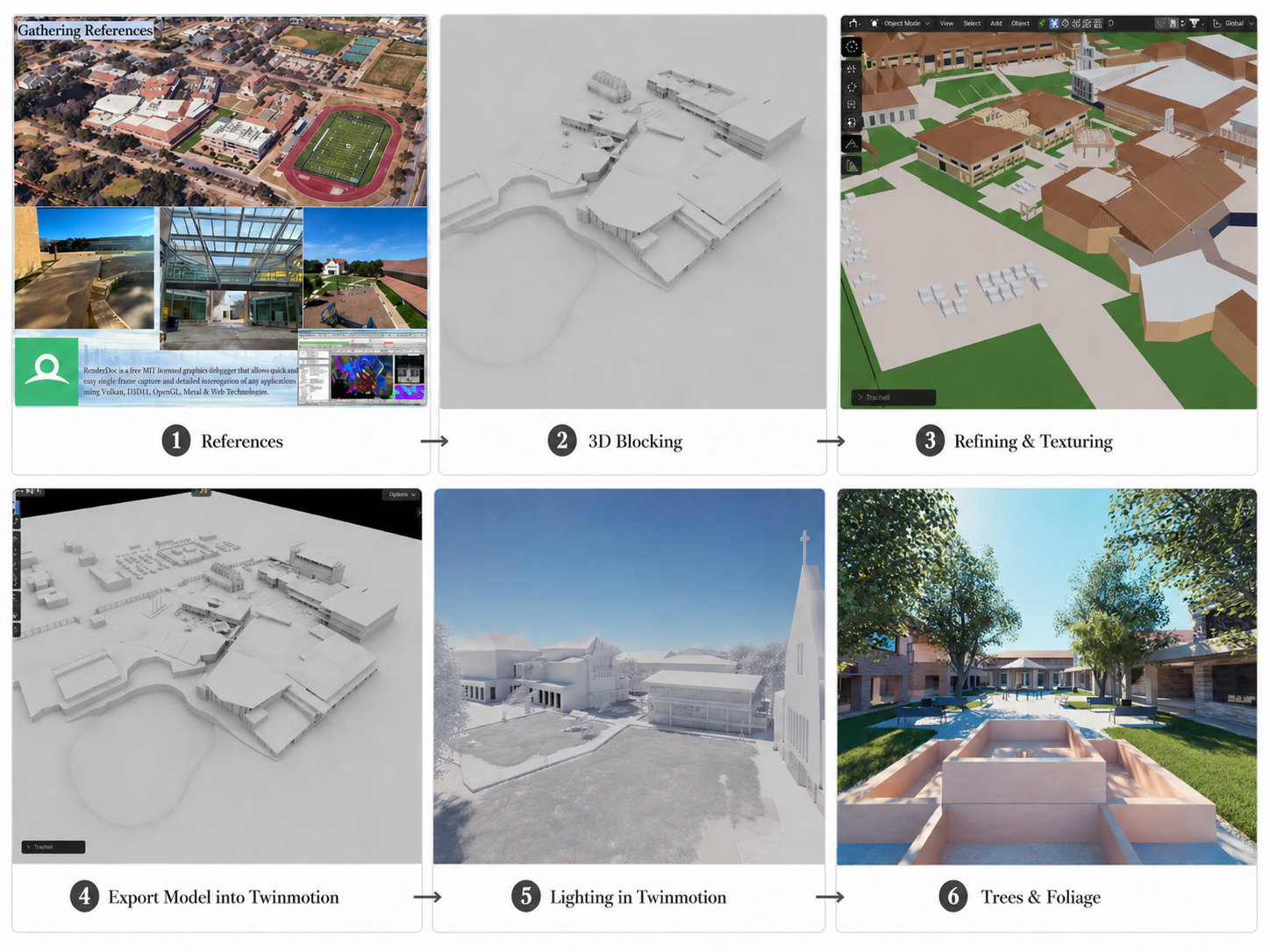
    Project workflow flowchart in light blue rectangular boxes connected by dark gray arrows snaking from top-left to bottom-right — Gathering references → 3D modeling, blocking → Refining and texturing → Export model into Twinmotion → Lighting in Twinmotion → Adding trees and foliage
    The summer in six boxes.
  24. Summer 2024 — the pavilion

    The shot the project was named for.

    Final ESD Pavilion render — modern geometric tiered light-stone water fountain in immediate foreground, manicured lawn beyond surrounded by wide paved walkways, large highly detailed trees casting dappled realistic shadows on grass and paths, brick buildings with large windows forming the perimeter of the courtyard, brightly lit by a simulated sun under a clear blue sky
    The pavilion shot.
  25. Fall 2024 — green-screen presentations

    The same loft game-room photo, this time on the left of a slide. On the right, me in a purple hoodie with the background keyed out — 3D skills creeping into how I gave talks, not just what I made.
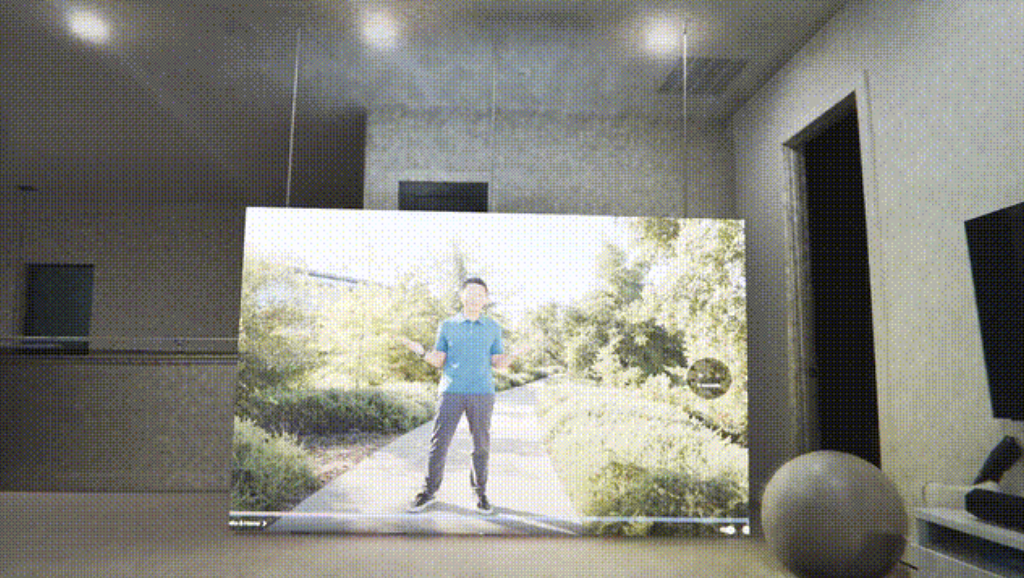
    Two images side by side — left, the original photograph of the real loft game room with brick wall, pool table, and green bean bags; right, video still of a young man in a dark purple hoodie standing and looking forward, his background completely removed and replaced with solid black, indicating green-screen or AI background-removal in use for a presentation
    Same room as 2016. Different use of the same skills.
  26. 2025 — the future

    Separator slide, not one of my renders: neon, scale, vehicles, and a quick marker for what comes next.

  27. 2025 — splats & generation

    Gaussian splats on the way in. Photoshop with Remove Background quietly running on aerial campus shots. The pipeline is starting to include things that didn't exist when I started.
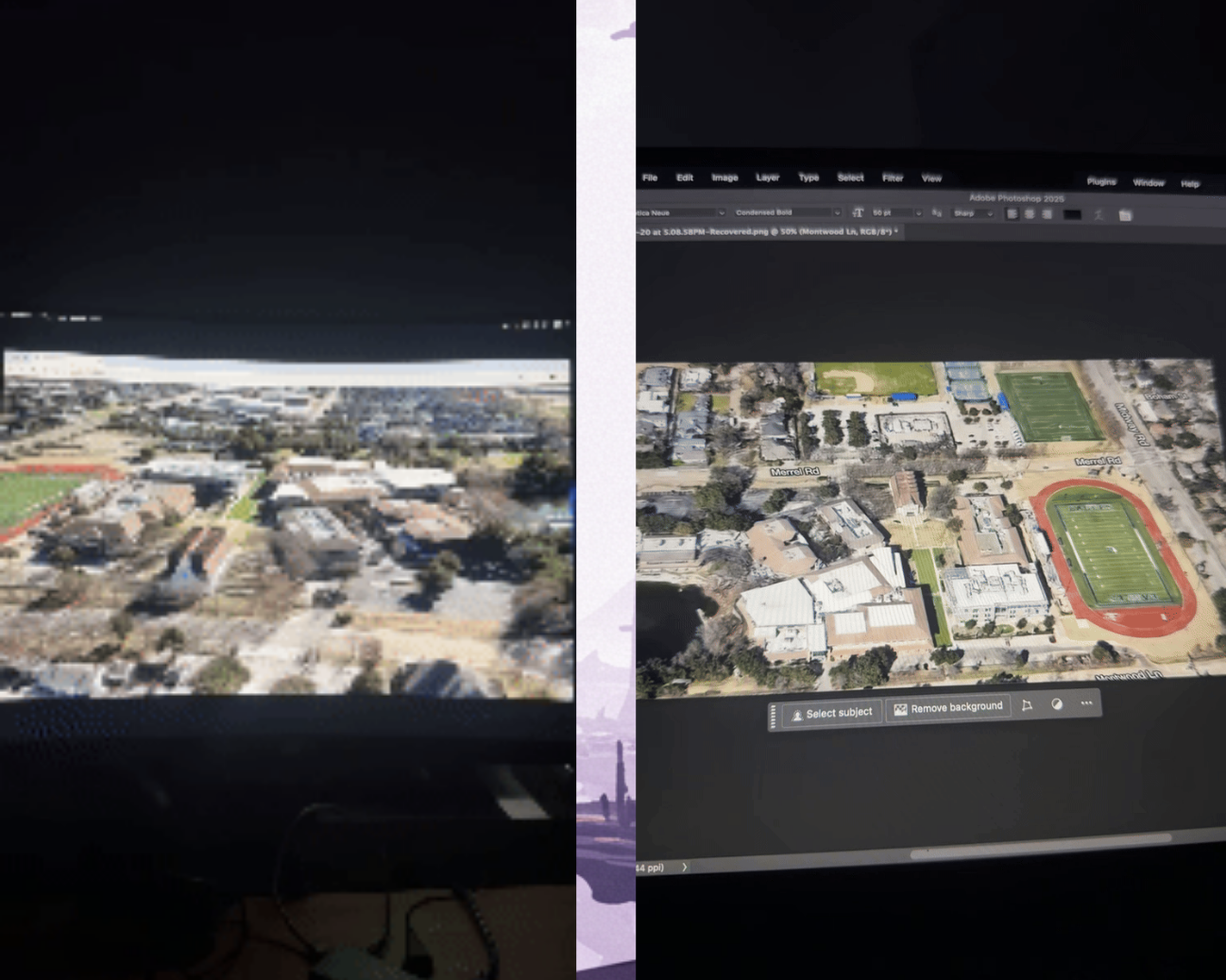
    Three-image board on a dark purple sci-fi landscape — left, a technical diagram illustrating Gaussian-splat-style 3D scanning showing a point cloud of a curved building facade with three wireframe pyramid camera positions projecting colored intersection lines onto the surface; middle, a warped heavily distorted panoramic raw scan of a school campus with a bright red running track and unnaturally curving edges; right, an Adobe Photoshop interface screenshot of an aerial satellite image of a school campus with the AI-powered Remove Background tool menu highlighted
    Splats, scans, and one quiet little AI button.
  28. 2025 — MetaHumans

    Raw head scans next to a screen of the person they're scanning. The frontier is a face you can drop into an engine.
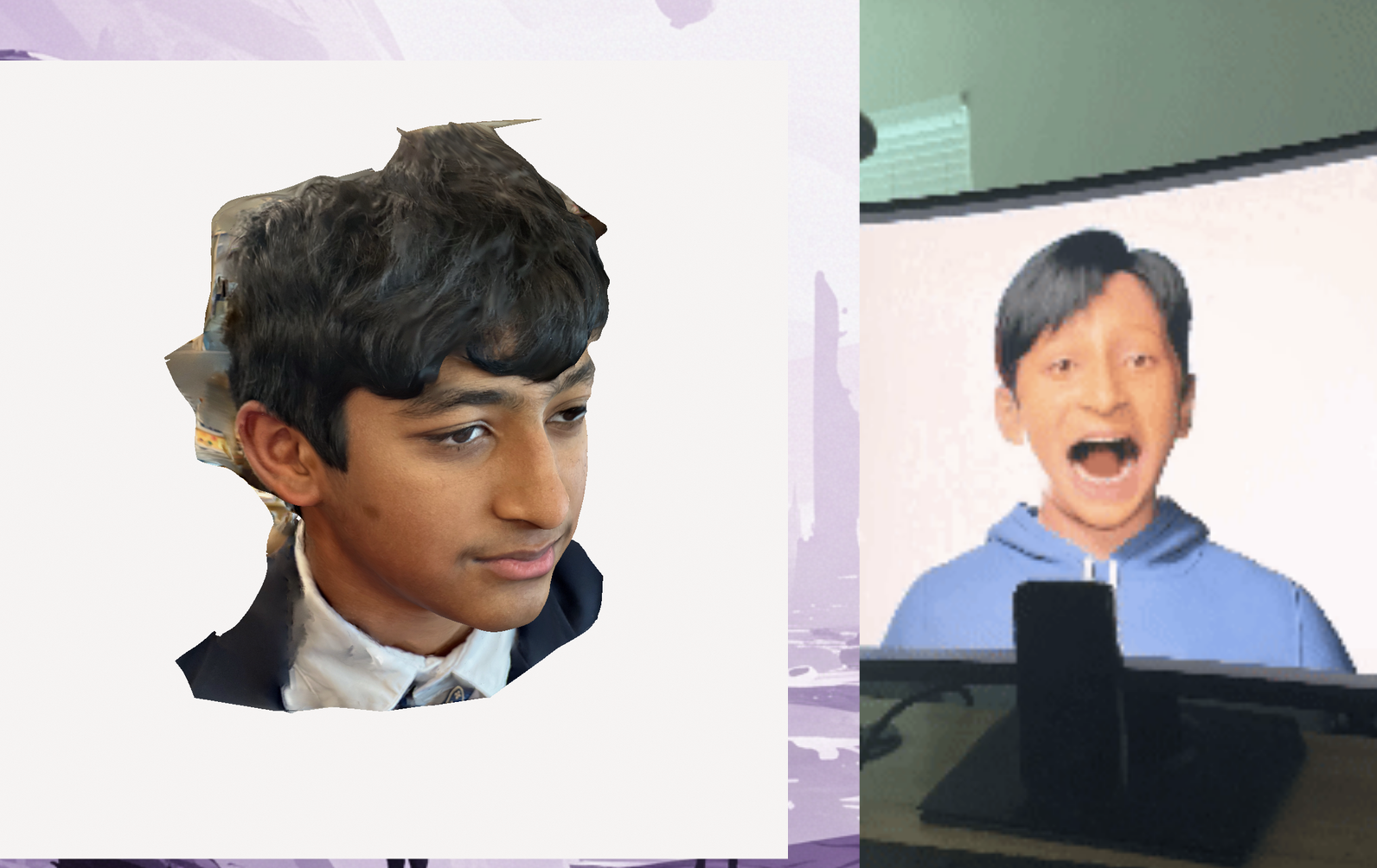
    Two images side by side relating to digital avatars on a dark purple sci-fi backdrop — left, a raw 3D scan of a young man's head and shoulders floating against a white background, the geometry imperfect with rough jagged edges where the scan data ends; right, a photograph of a computer monitor showing the same young man wearing a blue hoodie against a plain background, a small black scanner device sitting on the desk in front of the monitor
    MetaHumans. The head scan and the head.
  29. 2025 — toolbox

    The stack now lives across Blender, Fusion 360, Unreal, Photoshop, CapCut, Twinmotion, and After Effects. The tool changed; the habit stayed the same.

  30. Where to start, if asked

    Start with Blender Guru's donut, then keep making things that are slightly outside reach. That is the whole gateway.

From the gallery
Surreal close-up render of a furry cat's face bathed in purple and pink light, a perfect detailed earth-like planet reflected sharply in the cat's large glossy eye
Cat eye reflecting earth. The reflection lesson, as a render.
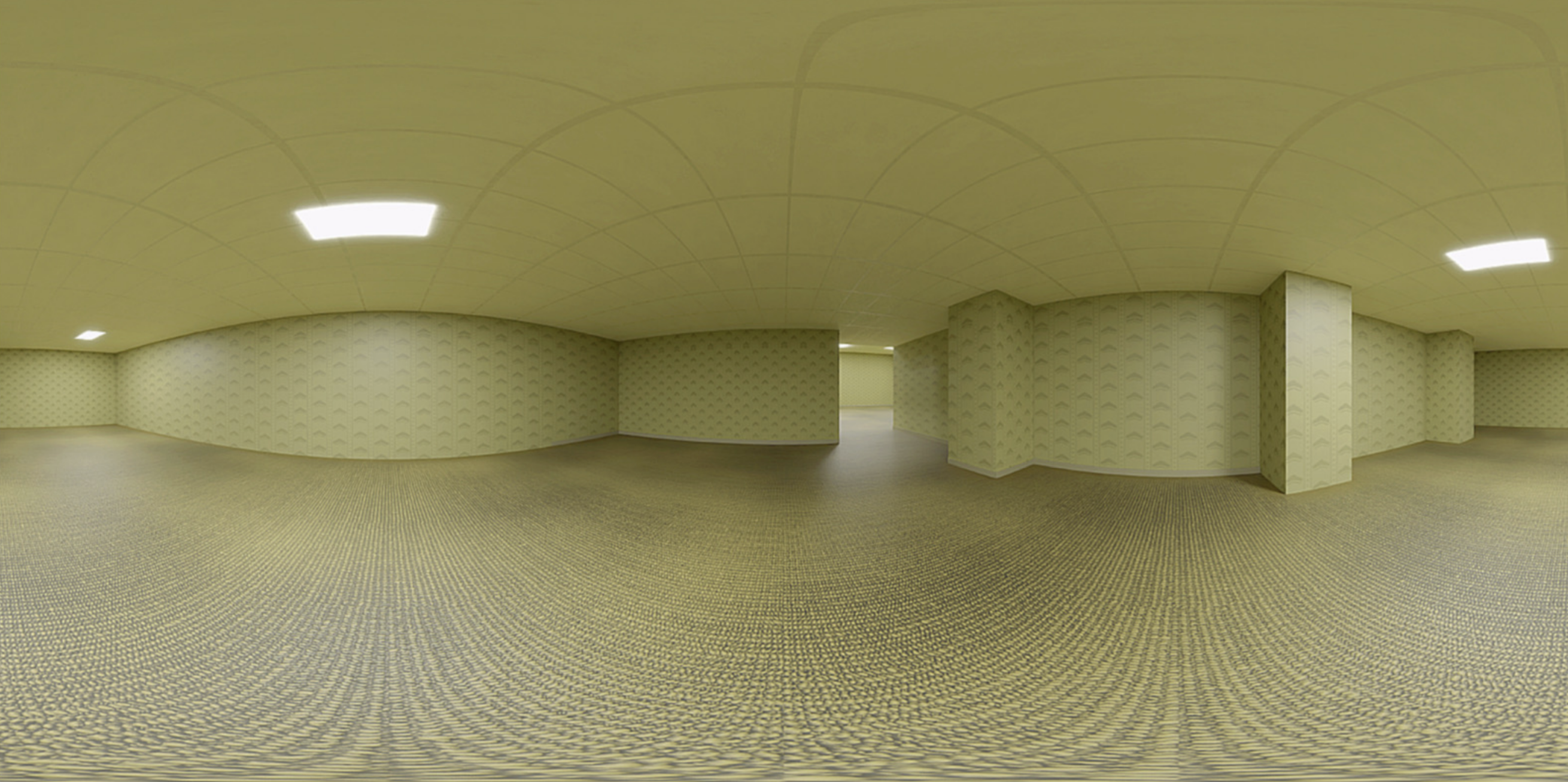
Wide panoramic render of the Backrooms liminal space — endless empty office environment, yellow patterned wallpaper, beige carpet, harsh fluorescent ceiling tiles repeating into the distance
Backrooms. Yellow walls, fluorescent infinity.
Frame from a realistic 3D suburban rain animation — wet asphalt, gloomy gray sky, modest houses, parked car along the curb, the whole shot framed like dashcam footage on a slow drive
Suburban rain. The animation that finally moved.
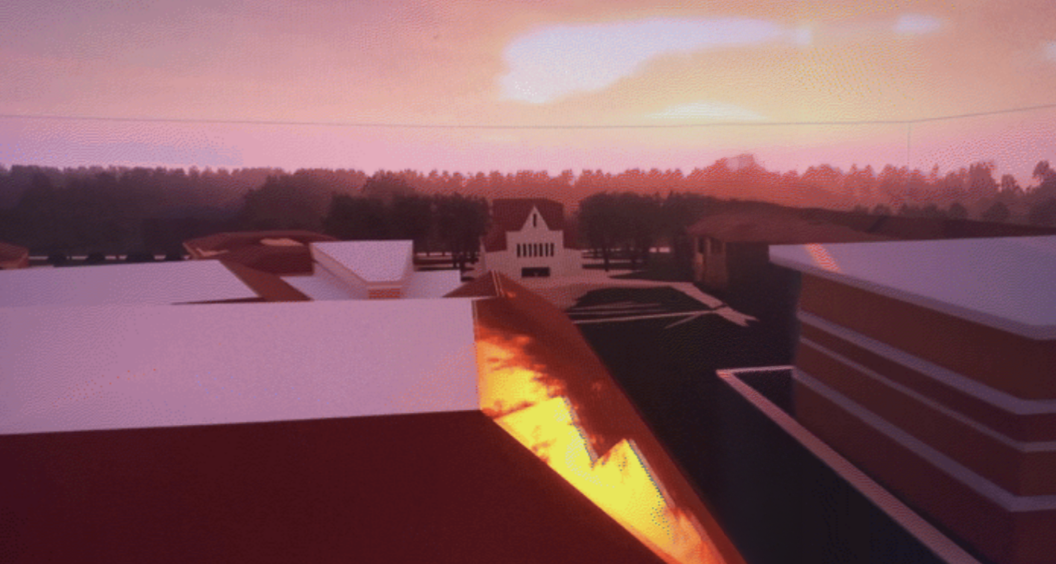
Atmospheric 3D render looking out over the rooftops of the ESD campus model at sunset — vibrant pink, purple, and orange hues filling the sky, bright glowing light reflecting intensely off a red building roof in the foreground
ESD sunset render. Pink and purple sky, hard glow on the red roof.
Side-by-side MetaHuman comparison — left, a raw 3D head scan of a young man with rough jagged geometry edges floating on a white background; right, a photograph of the same young man on a monitor wearing a blue hoodie, the scanner device visible on the desk in front
MetaHuman head scan beside its source.

What I came back with

13-year root system

Lesson from the terrain

Andrew Price's donut tutorial is the gateway — almost everyone in 3D started there, and I did too. What it actually teaches is that a craft is a stack of disciplines pretending to be one program: modeling, texturing, lighting, rendering, compositing, layout. Thirteen years in, every other thing I build — UI, hardware, arch viz, video — is some rearrangement of that same stack.

Cross-links

This fed into / from